The verification harness¶
Every contract in this toolkit used to be prose telling a model what to do — "review class leaves no files", "cap fix rounds at 2", "loop render → QA → fix until PASS". Nothing checked that it happened.
That failure mode is silent and remote. A skill stops honouring a rule, nothing complains, and it surfaces weeks later in a different repo as a secret that shipped or a diagram that coloured a failure state green.
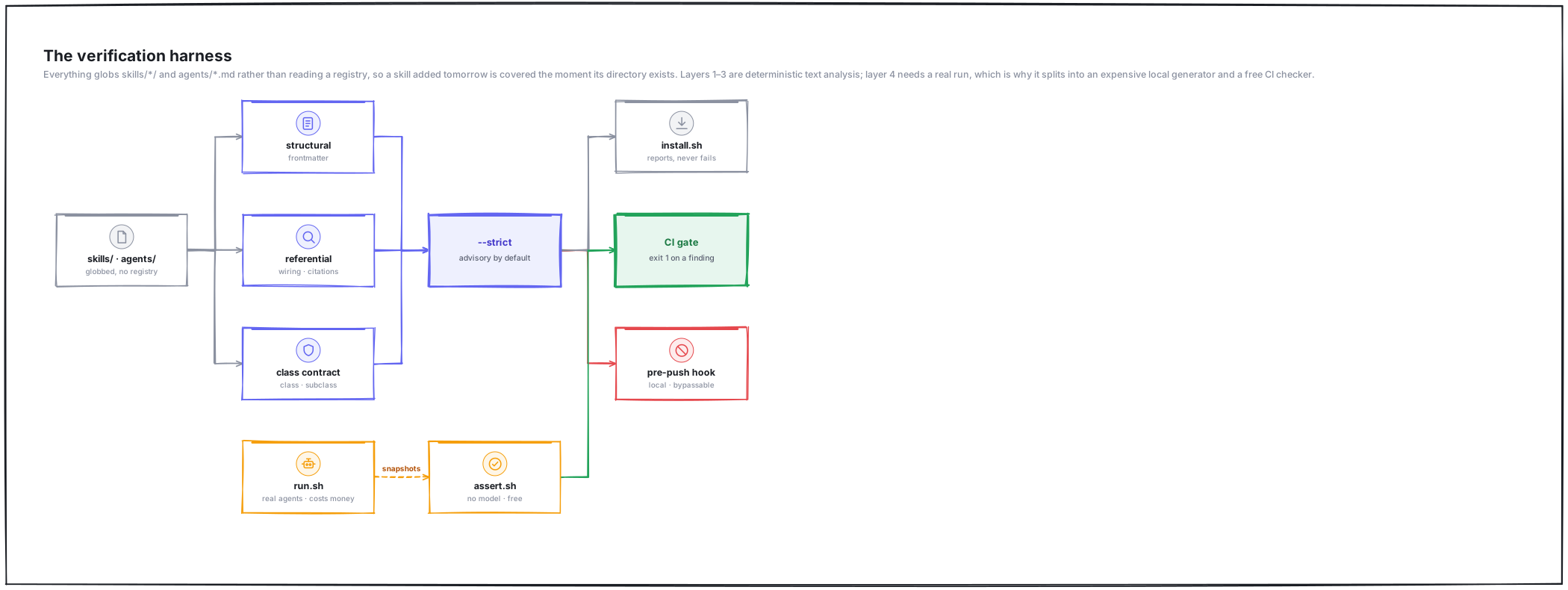
The harness closes it in four layers.
The layers¶
| Layer | What it does | Deterministic? |
|---|---|---|
| 1 · Structural | Frontmatter is present and well-formed; name matches the path |
Yes |
| 2 · Referential | Every agent a skill spawns exists; every agent is spawned by something; every § citation resolves |
Yes |
| 3 · Class contract | A skill honours the promises of the class it declares | Yes |
| 4 · Behavioural | The skill actually leaves no files, makes no commit, spawns no agent when it must not | No — needs a real run |
Layers 1–3 are check.sh: pure text analysis, about a second, no model involved.
Layer 4 is tests/, and it is the one that costs money — which is why it is split in
two.
Why layer 4 is split¶
tests/run.sh spawns real skills against disposable fixture repos and records what
happened. It spends money, so it runs locally and deliberately.
tests/assert.sh reads those committed snapshots back and checks them. No model, no
cost — so that is what CI runs, on every push.
The split is what makes behavioural assertions affordable at all.
What it cannot check¶
Worth stating plainly, because a harness that implies more coverage than it has is worse than none:
- Only negative contracts. "Left no files", "made no commit", "spawned no agent" are filesystem and process facts. "Found the right bugs" needs a model to judge and is out of scope.
- Snapshots are point-in-time. They record what a skill did on the day
run.shran, not what it would do today. - Prose discipline is unenforceable. "Halt on any signal to stop" is a rule for the model. Nothing mechanical can verify it was obeyed.
Forward coverage¶
The part that matters most: the harness binds skill #24, not just the ones that exist today.
Everything globs skills/*/ and agents/*.md rather than reading a registry, so a
skill added tomorrow is covered the moment its directory exists. There is no
registration step to forget — which is the same class of bug the harness exists to
catch, and it would be embarrassing to reproduce it inside the catcher.